
The Baboon: Key to Human Evolution.
Our similarities and differences from baboons are key to understanding the creative path our deep ancestors followed.

In at least six African caves where hominin fossils have been found, baboon fossils were also present. At Makapansgat, Raymond Dart found more than a hundred baboon skulls. He thought that Australopithecus had killed these baboons using weapons like antelope jaw bones, but modern evidence is that both hominins and baboons had been dragged into the cave by leopards. Both primates were hunted by the same predators in the same environment. Yet their body plans diverged dramatically. Why did arboreal monkeys evolve into the terrestrial body plan shared with dogs, while apes who settled the savanna gave us the unique human body plan?
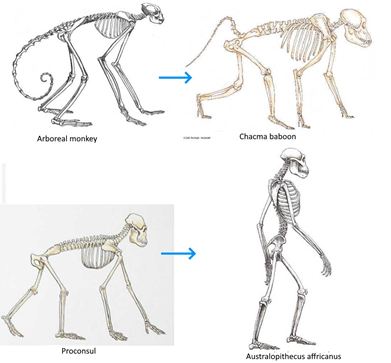
Figure 1: Arboreal monkey and ape body plans diverged on the savanna
What makes this a key question is that, judging from their living descendants, ancient hominins and baboons were both highly social, about the same size, both were conspicuously slow sprinters compared with other savanna prey species, and both could climb trees. So, in these respects, both presented the same problems and opportunities to a leopard predator. But would a leopard have expected the same reaction to being hunted, from such dramatically different prey? The simplest answer is that baboons presented themselves to their predators as prey that could bite, and hominins presented themselves as armed prey. That is surely how modern humans present themselves to predators, so the issue can be presented as a radical answer to the question: When did hominins become armed prey? What makes the answer radical is that the evidence used to infer that australopithecus was armed, also applies to Sahelanthropus who lived 4 million years before Australopithecus, and even to the European Anadoluvius turkae, 8.7 million years ago, even before the last common ancestor of humans and apes. That would imply that adaptations to terrestrial weapon use drove that split.
The biting baboon.
Male baboons are known for giving a yawning display of their great canine teeth, to whoever might be watching. Those watching might include other males in the troop, so this yawning habit can be interpreted as having to do with sexual selection. But the human response, as coming from a different species, is to be impressed by those teeth, and for that to be front of one’s mind. Consider what you would do, if you lived in the Cape Peninsula in South Africa, and you came into your house to find a baboon foraging in it. Google AI advises: ”remain calm and follow these steps: Identify the nearest exit, ensure it's not blocked, and open more windows/doors to provide escape routes if possible without cornering the baboon. If you are unable to encourage the baboon to leave on its own, call the Baboon Hotline at 071 588 6540”
This usefulness of baboon canines as defensive weapons is also shown in this YouTube video: titled “.
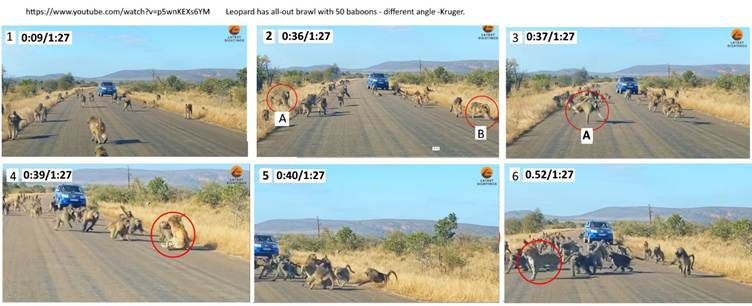
Figure 2: Screen shots from “All-out brawl between a leopard and 50 baboons in the Kruger Park”
At first the troop is strolling peaceably along the road but at 36 seconds male A has seen that female B, with an infant on her back, is being pursued by a leopard. A second later he is racing to intercept the leopard and at 0:39s the male collides head-on with the leopard, stopping it, while about 6 other males are rushing up in support. At 0:40s a brawl has developed, including on the right, a female who has discarded an infant in the grass. It is worth single-framing through the stages in the brawl that lasts for 12 seconds before the leopard gets up and flees.
How well would an unarmed hominin troop have coped with such an attack, bearing in mind the size of hominin canines, as shown in this pic:
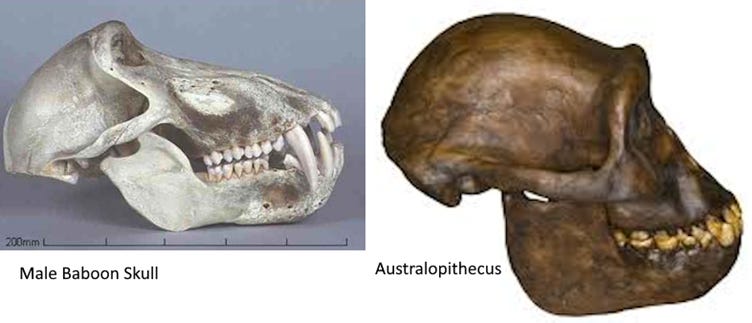
Figure 3: Baboon’s defensive adaptations to front of skull that were absent in Australopithecus
The baboon jaw is that of a plant-eater with a fearsome bite, while the australopithecus jaw, which humans have inherited, is only for eating. And the baboon’s frightening canine presentation to other species is typical of primates, it’s the hominin skull that is out of step. Other animals that get close to monkeys or apes need to know that they bite, and the primates help them to recognize that fact by showing their canines in gestures.
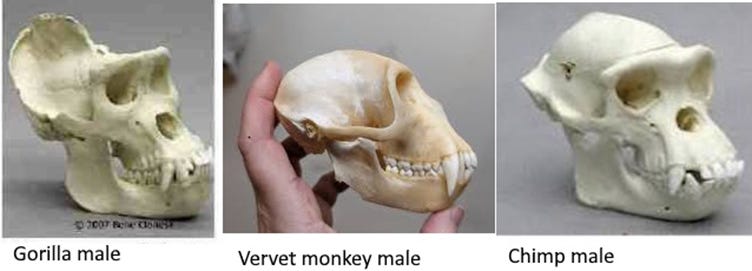
Figure 4: Large canines are typical of male primates
What kind of tools did australopithecus use?
Professor Dart recognised that Australopithecus’s lack of long canines and their bipedal body plan, was strong indirect evidence that they had been weapon users, and he proposed that their weapons had been the bones of other animals he had found associated with their fossils. He visualised an osteodontokeratic (bone, teeth, horns, or ODK) culture.
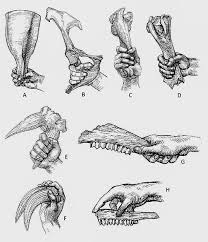
Figure 8: Dart’s idea that Australopithecus used bones as striking weapons.
The ODK theory has been replaced with the notion that hominins threw stones or used stones as hand clubs. The advantage of that theory, like the ODK, is that stones, like bones, can be produced as direct evidence. Crudely worked Oldowan pebbles have been dated to 2.6mya, overlapping with Australopithecus. But the problem with these theories is that both antelope jawbones and Oldowan pebbles aren’t good defensive weapons. What would be good would be wooden spears. The obvious objection that ape-brained hominins lacked the “cognition” needed to make spears can be met by pointing to the beaver’s dam building, birds building nests for later egg laying and hatching, and other elaborate sequenced activities by insects. This counter argument inevitably makes recourse to the long time periods involved in evolution, which is missing in arguments that invoke cognition to deny weapon-making by ancient hominins.
Figure 9 sketches out the activities that would be needed to make a thrusting spear as a “stopper” weapon, and to make the more problematic knobkerrie as a “striker”, used once an attacker had been halted and the initiative taken from it.
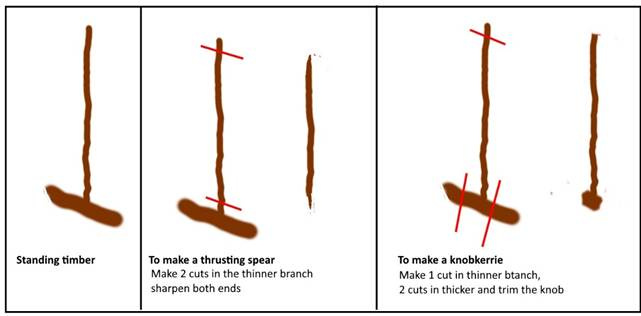
Figure 9. Steps in making a “stopper” and a “striker” weapon
This sketch brings out the laborious nature of making such weapons especially using unmodified stone tools. Even after the piece had been separated, hours of scraping work would be needed, maybe done on an outcrop of hard rock, Mammals aren’t known for such laborious work, except in activities like making burrows, but birds and insects do.
Wooden tools would generally have rapidly rotted away due to the food web around lignin as a food source, but the signs to look out for in a fossilised stick would be a pointed end, or the round heartwood of a kerrie knob.
The social implications of weapon use by ape-brained hominins.
The sequence shown in figure 2 illustrates that the success or failure of a predator attack can depend largely on what happens in the first few seconds. If the leopard had gained slightly more cover from a tourist car, it could have killed and made off with its kill before the baboon troop could have responded. In an equivalent hunt on a hominin troop, it would be useful to the troop if a predator could expect to immediately face a spear, whether in male or female hands. To use a seemingly ridiculous but profound analogy, it would have been adaptive for the whole troop to present itself within the food web as something like one very large two-dimensional porcupine, spread out on a patch of the savanna. Let us explore some of the interesting implications of that analogy, in the follow-up post.